
Central Committee Plenum Decision Mentions New Quality Productive Forces, General Aviation and the Low-Altitude Economy for the First Time
2024/07/29
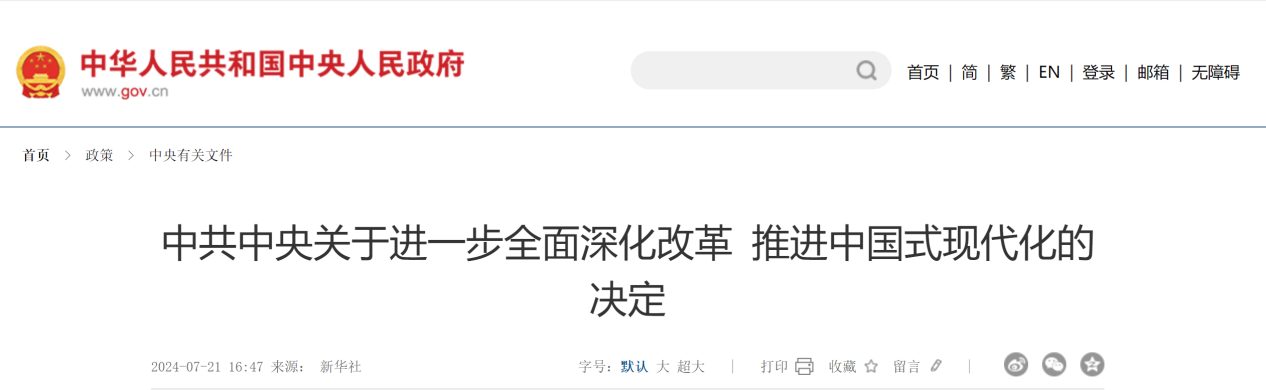
On July 21, the Decision of the CPC Central Committee on Further Comprehensively Deepening Reform and Advancing Chinese Modernization (the “Decision”), adopted at the Third Plenary Session of the 20th CPC Central Committee, was released. It explicitly calls for “developing general aviation and the low-altitude economy,” “improving institutions and mechanisms for developing new quality productive forces in light of local conditions,” and “accelerating the formation of production relations more compatible with new quality productive forces, and promoting the concentration of advanced factors of production toward them.” This is the first time a Central Committee plenary decision has included “new quality productive forces,” “general aviation,” and the “low-altitude economy.” “New quality productive forces” appears three times in the Decision, while “general aviation” and “low-altitude economy” together appear twice.
The Decision also mentions “aviation” twice (including the reference to general aviation above) and “aerospace” twice—for example: “establish a mechanism for growing investment in future industries, and improve policies and governance systems for strategic industries such as next-generation information technology, artificial intelligence, aerospace, new energy, new materials, high-end equipment, biomedicine, and quantum technology, guiding the healthy and orderly development of emerging industries,” and “strengthen overall planning for the development and management of aerospace, military trade, and related fields.” Notably, in national defense, “new-domain and new-quality combat forces” also appear for the first time in a plenary decision.
It is also worth noting that “artificial intelligence” appears four times in the Decision (including once as “generative artificial intelligence”). Beyond the passage above, the Decision calls for continuing the Belt and Road Science and Technology Innovation Action Plan and strengthening multilateral cooperation platforms in green development, the digital economy, AI, energy, taxation, finance, and disaster reduction; improving mechanisms for the development and management of generative AI; and establishing an AI security regulatory system.
Under the Constitution of the Communist Party of China, the National Congress is held every five years and convened by the Central Committee. Professor Zhang Xixian of the Party School of the CPC Central Committee has noted that Third Plenums typically focus on deepening economic reform. Looking back at successive Third Plenums since reform and opening-up began with the Third Plenum of 1978, each has laid a solid foundation for institutional change in China’s economy. This Decision anchors the goal of basically realizing socialist modernization by 2035 and prioritizes major reform measures for the next five years.
The Decision also mentions “aviation” twice (including the reference to general aviation above) and “aerospace” twice—for example: “establish a mechanism for growing investment in future industries, and improve policies and governance systems for strategic industries such as next-generation information technology, artificial intelligence, aerospace, new energy, new materials, high-end equipment, biomedicine, and quantum technology, guiding the healthy and orderly development of emerging industries,” and “strengthen overall planning for the development and management of aerospace, military trade, and related fields.” Notably, in national defense, “new-domain and new-quality combat forces” also appear for the first time in a plenary decision.
It is also worth noting that “artificial intelligence” appears four times in the Decision (including once as “generative artificial intelligence”). Beyond the passage above, the Decision calls for continuing the Belt and Road Science and Technology Innovation Action Plan and strengthening multilateral cooperation platforms in green development, the digital economy, AI, energy, taxation, finance, and disaster reduction; improving mechanisms for the development and management of generative AI; and establishing an AI security regulatory system.
Under the Constitution of the Communist Party of China, the National Congress is held every five years and convened by the Central Committee. Professor Zhang Xixian of the Party School of the CPC Central Committee has noted that Third Plenums typically focus on deepening economic reform. Looking back at successive Third Plenums since reform and opening-up began with the Third Plenum of 1978, each has laid a solid foundation for institutional change in China’s economy. This Decision anchors the goal of basically realizing socialist modernization by 2035 and prioritizes major reform measures for the next five years.